Deterministic tasks
- Identity and data freshness
- Unit conversion and movement precedence
- HRV and RHR suppression gates
- Expected-weight calculations
- State certification and fallbacks
Flagship case study · health and performance intelligence
CoachAI → Apex Human Hybrid
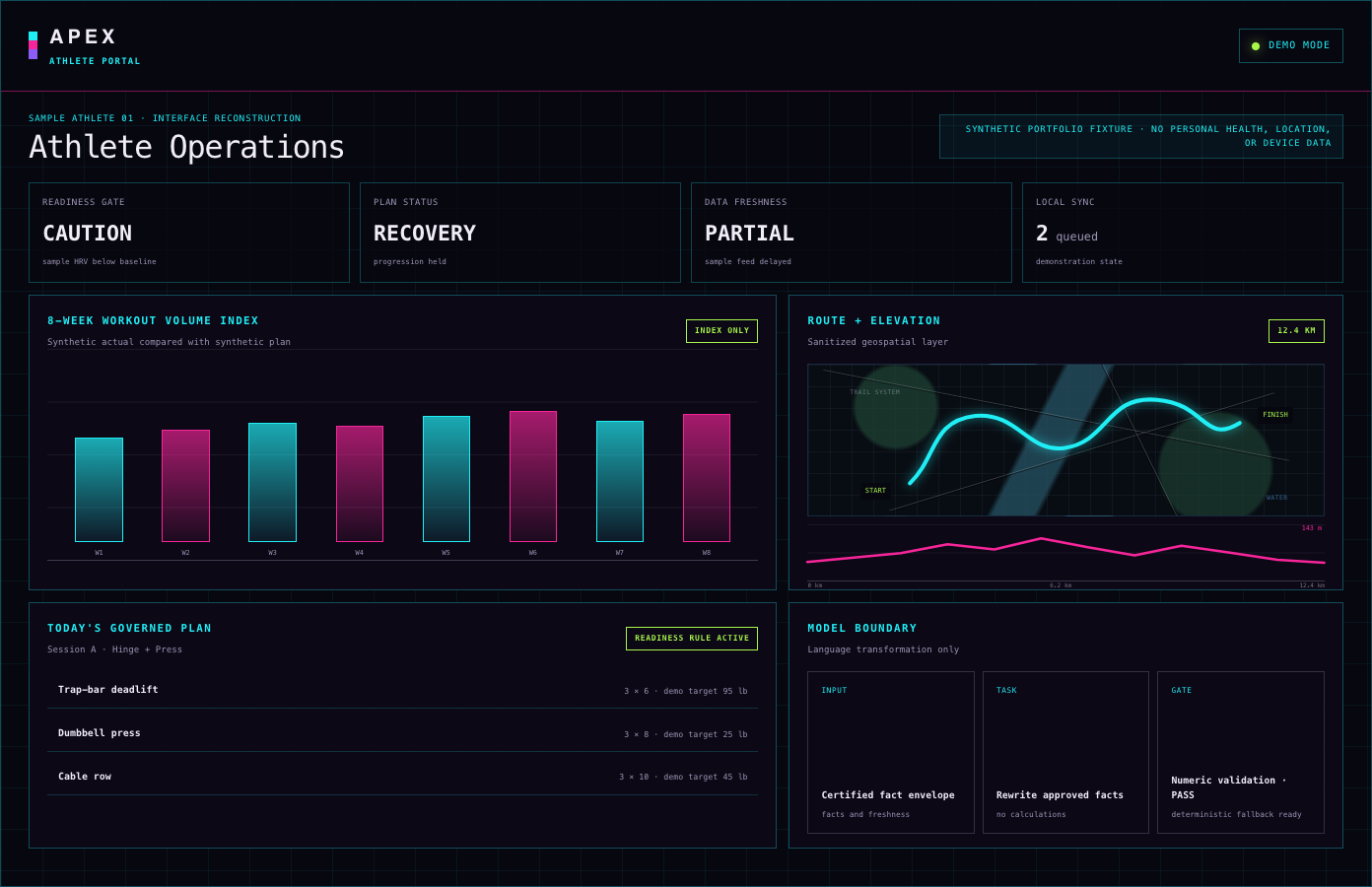
I built and operate Apex Human Hybrid as a private application connecting training plans with workout history, recovery signals, route analysis, and race results. It grew from CoachAI as repeated loading of years of history consumed increasing tokens and credits. I designed the PostgreSQL/PostGIS data model, ingestion pipelines, APIs, readiness calculations, model routing, and web clients, with a locally built Swift wrapper for mobile access.
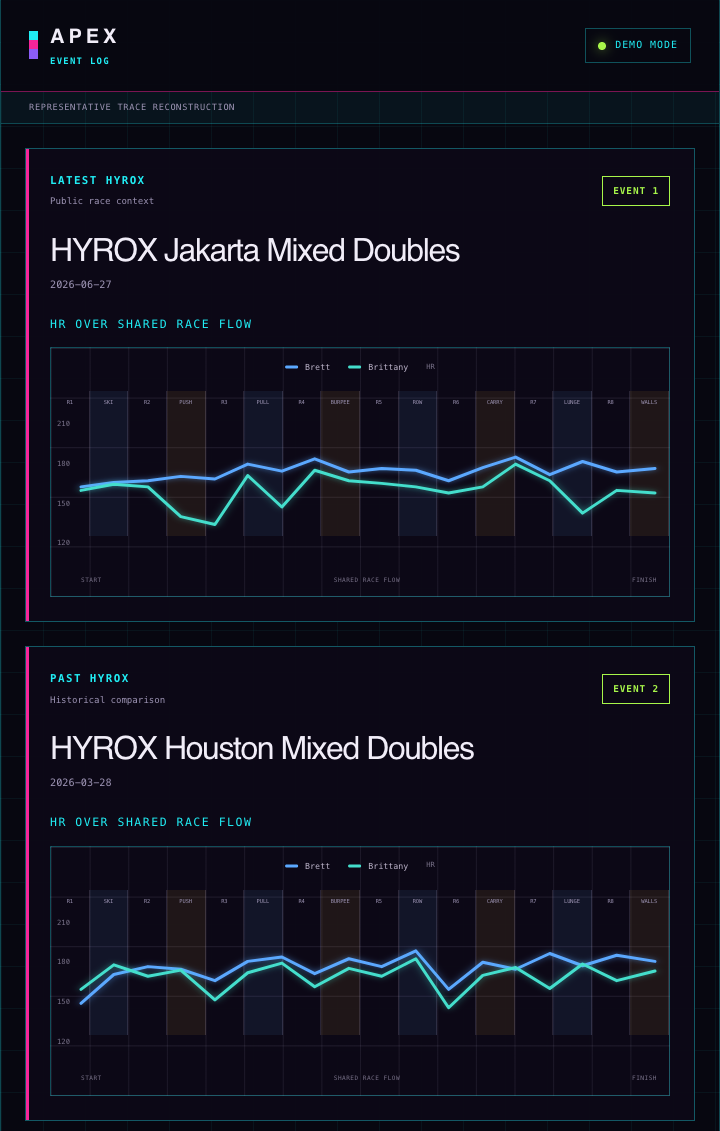
Repository evidence records 135 tracked migrations, 42 certified state releases, and 12,415 workout-set rows in the dated production snapshot. These figures measure platform scale and data maturity. Performance improvement is tracked separately through longitudinal training, physiology, and race outcomes. The documented athlete record includes a VO2 max estimate rising 3.9% to 39.53 mL/kg/min over about five weeks, up from a 30.1 trough in 2024, and a Houston 2026 HYROX result that improved one minute overall and 5:13 in total running time versus Dallas 2025. These are measured outcomes, without a causal claim that the software produced them.
Screens & Evidence
01 / Problem
The original CoachAI file bundle preserved years of training history, physiological baselines, movement identity, and coaching rules. As the datasets and guardrails grew, each model session had to reload more context. Token and credit use increased while targeted analysis became harder to isolate.
The application moved calculation, freshness, state, and suppression rules into deterministic services. Models receive smaller fact packets for a specific task and may explain approved state. Canonical facts and workout loads remain under deterministic control.
02 / Evolution
Eleven volatility-aware files separated daily state from stable athlete facts.
PostgreSQL/PostGIS, Python ETL, layered schemas, and certified snapshots became the source of truth.
FastAPI served a Vue portal, React Gym PWA, and Swift wrapper with offline work.
Certified state releases, validation, and fallback text support ongoing use of the private application.
03 / What I built
04 / Architecture
Simplified architecture of the private application, showing how training data becomes validated state and coaching context.
05 / System Boundary
06 / Reliability
State releases use hashes, locks, and atomic promotion. Ambiguous mappings enter a review queue. Unsupported model values fail validation and return precomputed text.
Data freshness and fallback states remain visible in the coaching workflow, so a delayed health feed or failed model response can be distinguished from current training information.
07 / Outcomes
A prompt-based coaching workflow became a database-backed application with ETL, APIs, clients, release state, and explicit authority boundaries.
The athlete record shows a VO2 max estimate rising 3.9% to 39.53 mL/kg/min over about five weeks, up from a 30.1 trough in 2024. Houston 2026 improved one minute overall and 5:13 in total running time versus Dallas 2025.
The system records and analyzes these outcomes. The available evidence does not establish that the software caused the physiology or race improvements.